
An Idiot’s Guide to Funding
For most founders, raising money is a daunting process. There is a sea of investors, lenders and funds, each with their own terminology, criteria, expectations and processes. Finding money is rarely the problem. Finding the right money, from the right source, at the right time and on the right terms, is considerably harder.
There are plenty of tripwires. Raise too little and you may be back looking for money before achieving the milestones needed for the next round. Raise at an unrealistic valuation and that valuation can come back to bite you. Choose the wrong type of capital and you can restrict your options later.
Funding therefore needs to be considered as a journey. What you raise, from whom, on what terms and at what valuation should make sense not only today, but for where the business needs to be in two, three or five years.
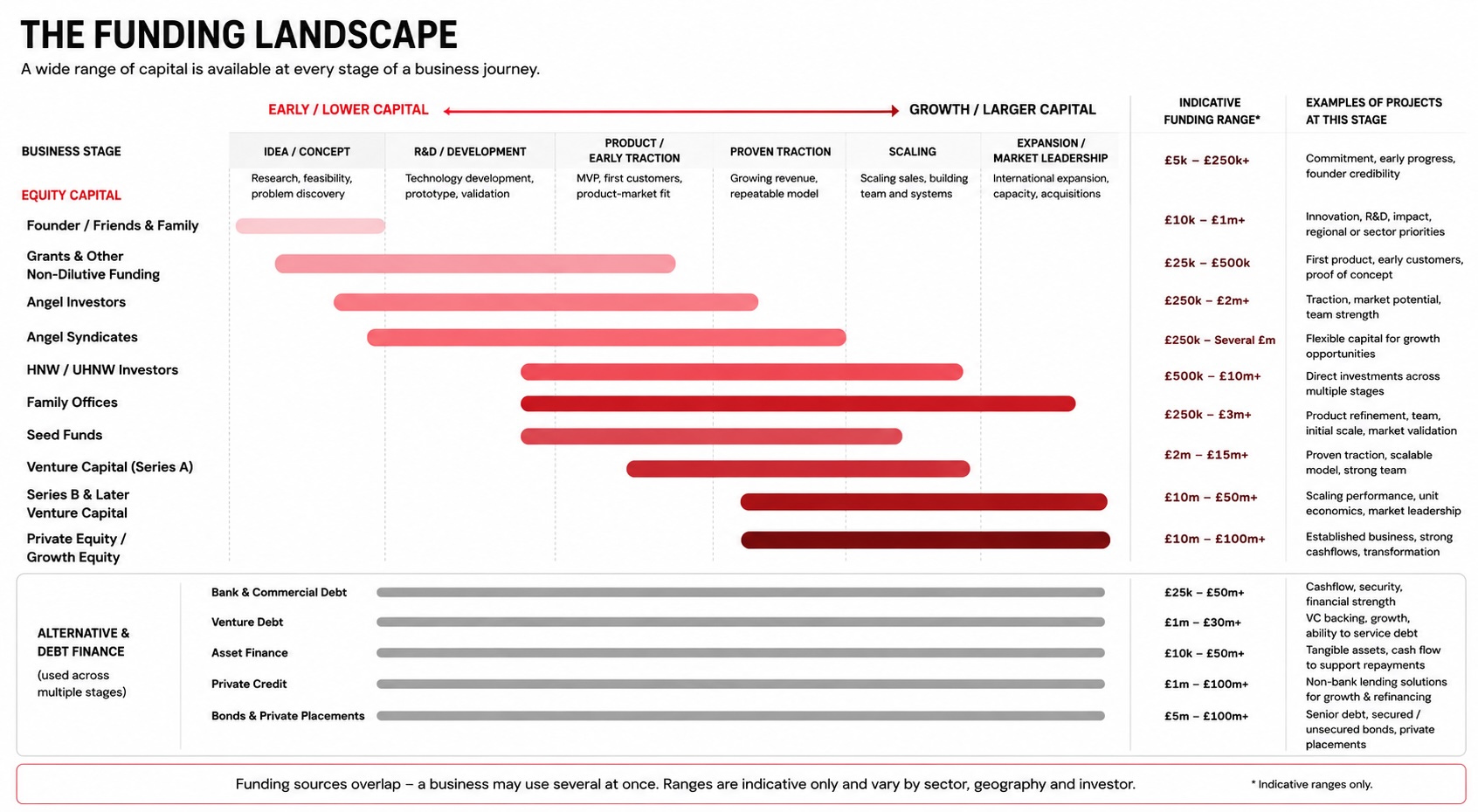
There are many variations and hybrids, but most business funding sits somewhere within the following:
- Founder funding and bootstrapping
- Friends and family
- Grants and other non-dilutive funding
- Angel investors
- Angel syndicates
- High Net Worth and Ultra High Net Worth investors
- Family offices
- Pre-seed and seed funds
- Venture capital
- Series A
- Series B and later-stage growth capital
- Corporate venture capital and strategic investors
- Equity crowdfunding
- Bank and commercial debt
- Venture debt
- Asset finance
- Private credit
- Bonds and private placements
- Growth equity and private equity
- Public markets
These aren’t rigid steps on a ladder, and a business may use several at the same time. An asset-heavy growth company, for example, could combine equity for growth and working capital with asset finance for equipment. The question is not simply what funding is available, but what combination of capital best supports the business and its next stage.
Starting at the beginning
Founder, friends and family funding usually sits at the beginning, funding development before a proposition is sufficiently mature for external investors. It offers considerable freedom, but the amount available is usually limited and the financial risk is personal.
Grants and non-dilutive funding can be attractive because the business may receive capital without surrendering equity. They commonly come with eligibility criteria, restrictions on expenditure, reporting requirements and sometimes matched funding, and are particularly relevant to areas such as innovation, R&D, sustainability and regional development.
Angel investors invest their own money and commonly appear once a business needs external capital but remains too early for many institutional funds. British Business Bank guidance puts individual angel investments broadly between £5,000 and £500,000, with larger syndicates potentially reaching around £2 million. Angels can also bring sector experience, contacts and practical support.
Angel syndicates bring several investors together, allowing larger investments while spreading individual risk. For the business, this can provide substantially more capital without immediately moving into institutional venture capital.
HNW, UHNW and family office capital
High Net Worth and Ultra High Net Worth investors occupy an interesting part of the market. Like angels, they are investing their own capital, but the sums can be considerably larger and their interests can extend from relatively early opportunities through to substantial growth transactions.
Family offices manage the wealth of one or more wealthy families. Some invest directly into businesses, while others operate much more like institutional funds. They can have greater flexibility over investment horizon, structure and stage than a conventional VC fund, although there is no particularly useful standard cheque size because their strategies and resources vary enormously.
That flexibility makes understanding the individual investor important. Knowing somebody has substantial wealth tells you very little about whether they want to invest in your business, why they would do so or what they will expect in return.
Seed and venture capital
Pre-seed is generally about turning an idea into something tangible, perhaps through research, developing an MVP, proving the technology or establishing whether a market exists.
Seed funding takes the proposition further. Capital may be used to refine the product, build the team, establish product-market fit and generate commercial traction. Investors can include angels, specialist seed funds and early-stage VCs.
The numbers vary considerably, which makes statements such as “a seed round is £500,000” fairly meaningless. In the UK, £2.1 billion was invested at seed stage during 2025. The median seed pre-money valuation was £3.2 million, compared with an average of £6 million, illustrating how easily averages can be distorted by larger transactions.
Series A usually marks a change in the conversation. The business should increasingly be able to demonstrate that the proposition works, there is genuine market demand and additional capital can accelerate growth rather than simply keep an experiment alive.
Series B and later venture rounds move further towards scaling an established growth engine. International expansion, additional capacity, infrastructure, acquisitions and market share become more relevant. The money generally becomes larger, but so does the expectation of evidence.
British Business Bank figures illustrate the range. In 2025, the average UK venture-stage deal was £5.8 million, although the median was only £1.1 million. At growth stage, the average was £14.3 million and the median £2.6 million. Averages can therefore give a misleading impression of what a typical transaction actually looks like.
Strategic investors and corporate venture capital
A strategic investor is interested in more than the financial return. Your technology, intellectual property, customers, market position or capability may complement their existing business.
Corporate venture capital can therefore bring money alongside distribution, market access, technical capability or commercial credibility. However, alignment with one industry participant can affect relationships with its competitors, so the longer-term implications need considering alongside the immediate investment.
Debt is capital too
Funding conversations often become unnecessarily focused on equity. Giving away part of the company is only one way of financing growth.
Bank and commercial debt can work where a business has sufficient cash flow and creditworthiness to service borrowing. There is no equity dilution, but the debt has to be serviced regardless of whether the growth plan performs as expected.
Venture debt can provide additional capital to venture-backed businesses without the same dilution as another equity round. It still introduces repayment obligations and normally requires sufficient backing, performance or prospects to support the lender’s risk.
Asset finance is particularly relevant where capital is required for identifiable equipment, machinery, vehicles or other productive assets. Rather than financing the whole growth requirement through equity, those assets can support a separate financing structure.
Private credit provides another source of non-bank lending, generally for larger or more established businesses. It can offer structural flexibility, but pricing, security, covenants and repayment capacity become important.
Bonds and private placements take this further. The business raises debt from investors with defined interest and repayment obligations and, depending on the instrument, security and covenants. These routes become relevant as the funding requirement and financial maturity of the business increase.
Valuation, the number that can come back to bite you
Founders understandably want the highest valuation possible because it means surrendering less equity for the same amount of money. Raise £1 million at a £4 million pre-money valuation and the investor owns 20% after the investment. Raise it at £9 million and they own 10%.
The problem comes at the next round if the business has not grown sufficiently to support that higher valuation. A new investor may refuse to accept it, creating a flat or down round, further dilution and potentially difficult consequences for existing shareholders. Valuation therefore needs to reflect both what can be achieved today and what the business can reasonably support when it next needs capital.
The highest valuation is not necessarily the best valuation.
So how do you actually find the money?
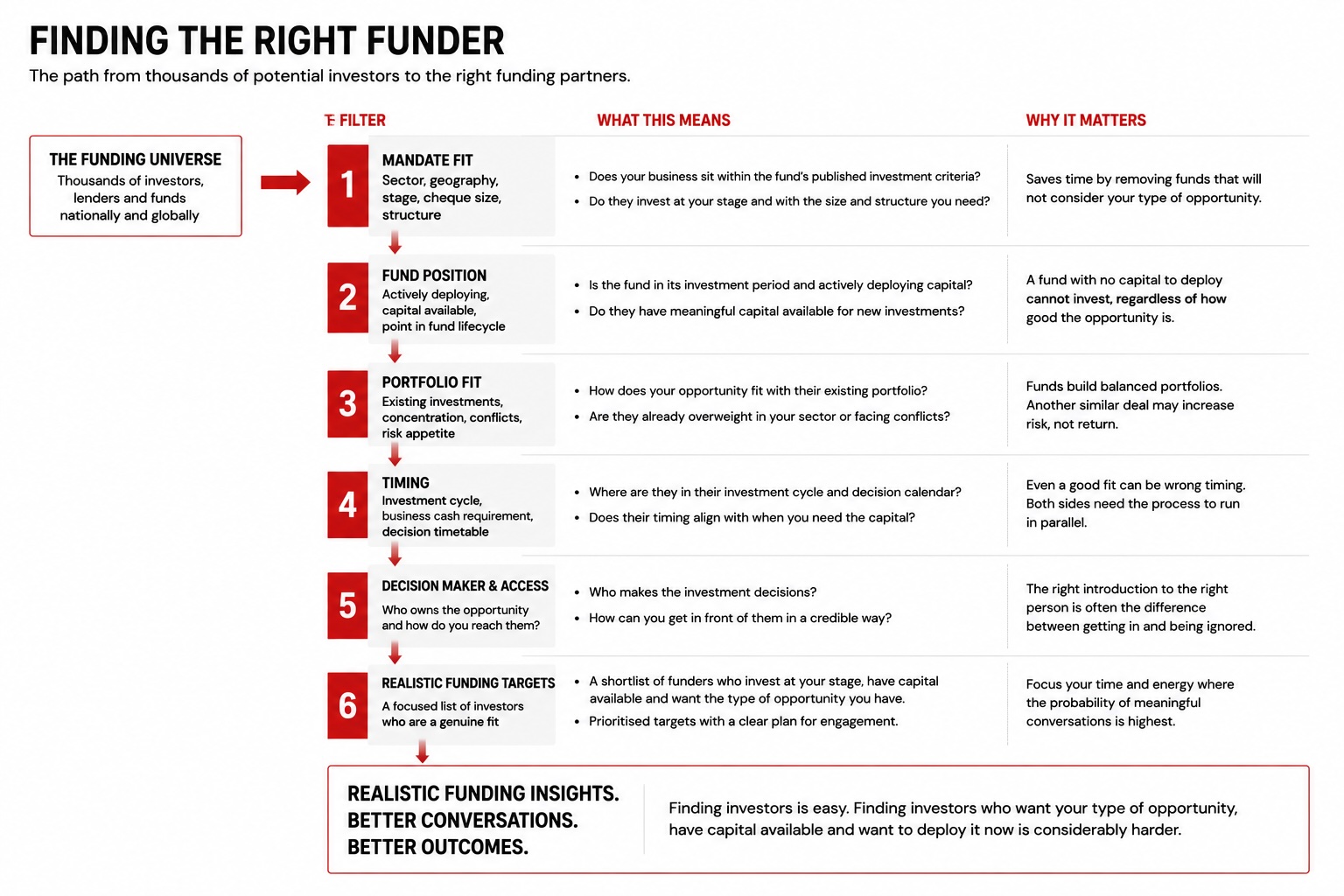
This is where fundraising becomes considerably more complicated than searching online for venture capital funds. There are thousands of potential sources of capital, spread nationally and internationally, with different requirements around sector, geography, stage, cheque size, technology, traction, structure and risk.
At the institutional level, the fund itself has a lifecycle. A newly raised fund with substantial undeployed capital is a different prospect from one approaching the end of its investment period. Funds commonly reserve capital to support existing portfolio companies through subsequent rounds, so the amount under management is not necessarily the amount available for new investments.
Portfolio composition matters too. A fund may specialise in exactly your sector but already have sufficient exposure to it, making another similar investment unattractive from a portfolio risk perspective.
Being inside a fund’s mandate does not mean the fund wants your deal.
Finding the right target therefore means understanding who is actively investing, what they want, where they are in their fund cycle, what they already hold and who makes the investment decisions.
Timing also matters. Easter, summer holidays and Christmas can slow a process when partners, investment committees, lawyers and co-investors need to be available. The funding timetable therefore needs to work backwards from when the business actually needs the cash, with sufficient contingency for a process taking longer than expected.
Getting through the door
Once suitable funders have been identified, you still have to reach them. Cold approaches can work, but trusted introductions remain valuable. The British Business Bank specifically identifies an introduction from somebody the VC trusts, such as another entrepreneur, investor, lawyer or colleague, as one of the best routes into venture capital.
Getting through the door is only the beginning. A pitch deck may lead to initial screening, management meetings, further information, due diligence, a data room and ultimately an investment committee. At every stage the funder is deciding whether the opportunity justifies progressing further.
That filtering exists because investors receive far more opportunities than they can fund. The UK market became more selective during 2025, with smaller-business equity investment falling 4% to £12.3 billion and seed and venture deal numbers falling 27% and 13% respectively. Capital became increasingly concentrated into fewer, larger transactions.
The changing front door
Historically, initial screening was often undertaken by analysts and associates reviewing pitch decks, financial information and market propositions before deciding which opportunities deserved senior attention. Increasingly, AI and automation are being introduced into sourcing, screening, analysis and due diligence.
That has advantages for investors because far more information can be processed quickly and consistently. For founders, however, it means the proposition increasingly has to survive a systematic first assessment before there is necessarily an opportunity to explain its nuances to a senior investment decision-maker.
This makes preparation more important, not less. The pitch deck, financial model, market evidence and supporting information need to tell the same story, because inconsistencies that might once have emerged during a conversation can increasingly become reasons for an opportunity not progressing.
What does a funder actually want to see?
Different capital providers have different expectations, but the underlying questions are surprisingly consistent. Is there a genuine market? Does the product solve a real problem? Will customers buy it? Can the business scale? Is the financial model credible? Is the valuation supportable? What could prevent the plan being delivered, and has management considered and mitigated those risks? Does the team have the capability to execute?
As the business progresses, evidence increasingly replaces promise. A prototype becomes a commercial product, leads become a qualified sales forecast, forecast sales become contracts and contracts become revenue. The expectations change with each funding stage because the business should have more evidence available to support its claims.
Governance also becomes increasingly important. A funder is not simply investing in the spreadsheet placed in front of them. They are investing in management’s ability to understand when reality diverges from the plan and take corrective action.
Why spray and pray rarely works
It is tempting to build a list of hundreds of investors, send everybody the same deck and hope something sticks. Poorly targeted approaches consume management time and ignore the more important question of whether the capital being pursued is actually appropriate for the business.
A database can tell you that a fund exists and perhaps what its published investment criteria are. It cannot necessarily tell you whether it has capital available today, whether its appetite has changed, whether its portfolio is already overweight in your sector or whether the relevant partner wants another investment like yours. Those are the things that determine whether an apparently perfect fund is actually a realistic prospect.
The Kognise approach
Kognise works across the capital journey, typically from HNW and UHNW investors and family offices through venture capital, Series A and Series B, alongside lenders, asset finance and other institutional capital where appropriate.
We don’t start with a database and work out how many pitch decks we can distribute. We work directly with founders, principals, boards and investment decision-makers across our funding network, which gives us an understanding of what they are actually looking for rather than simply what their published mandate says.
Those relationships work both ways. A company needs access to appropriate capital, but a funder also needs confidence that an opportunity brought to them has been properly considered and has legs. Maintaining that trust means being prepared to tell a business when it isn’t ready to raise, when the proposition needs more work or when the capital it is pursuing is wrong for its stage.
Early-stage investment inevitably involves risk, and funders know that. Their job is to understand and price that risk, build an appropriate portfolio and identify businesses where the potential return justifies taking it. Our role is to make sure the business understands what that funder will expect and is capable of supporting the proposition it puts forward.
Think beyond the next cheque
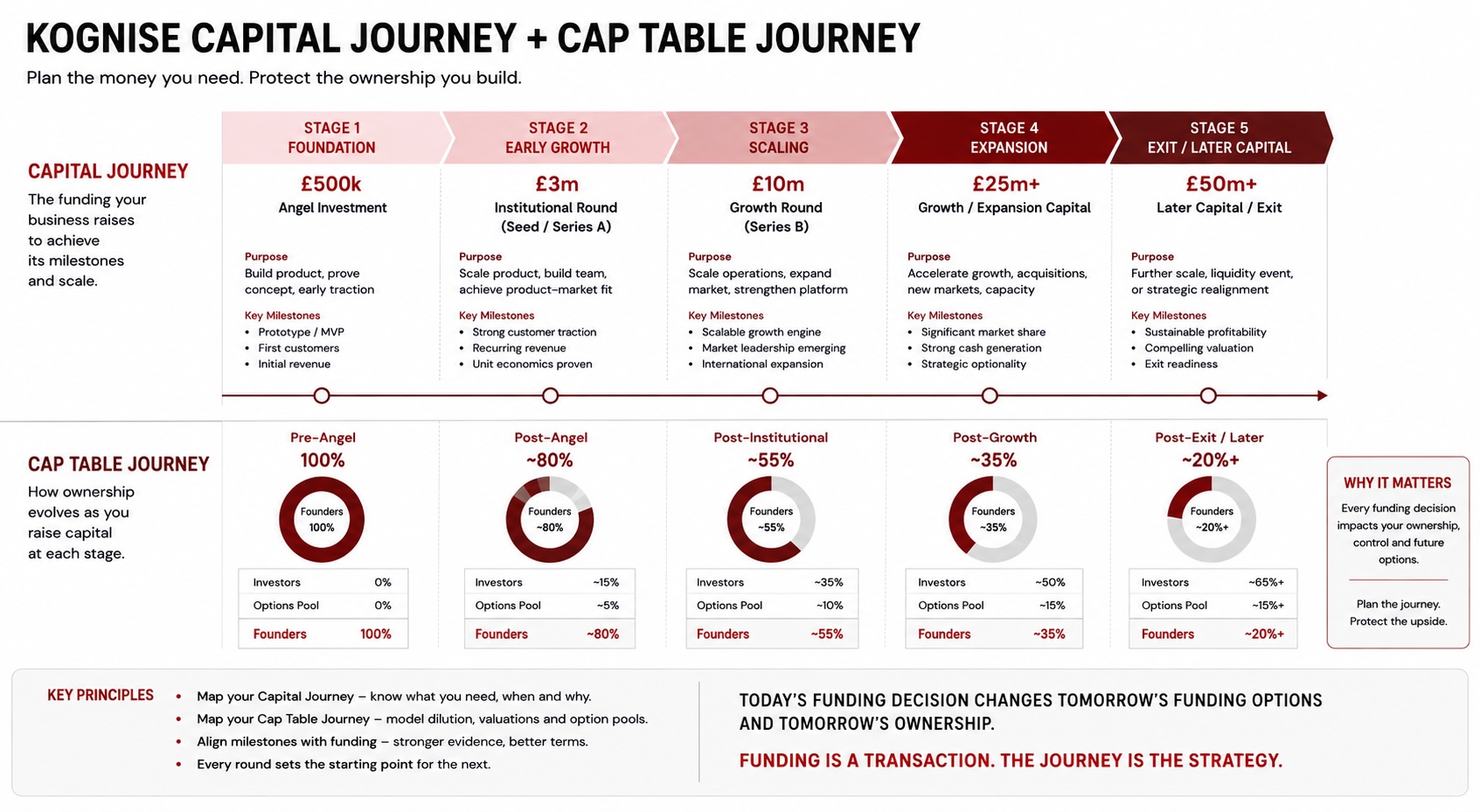
A £500,000 angel investment, a £3 million institutional round and a later £10 million growth facility are not three unrelated transactions. They form part of the same Capital Journey, with each stage changing the business that approaches the next funder.
At Kognise, we map that Capital Journey forward, looking at what funding is required at each stage, what it needs to achieve and what evidence the business must create before the next raise. Alongside it sits the Cap Table Journey, modelling how successive equity rounds, valuations and dilution affect founders and existing shareholders over time.
This matters because an investment that looks attractive in isolation can produce a very different outcome several rounds later. Without considering the likely funding journey at the outset, successive equity raises can progressively chip away at founder ownership, particularly where valuations or capital requirements do not develop as expected.
The objective is therefore not simply to get the next cheque. It is to understand the route from £500,000 to £3 million to £10 million and beyond, and structure each stage so that it supports rather than compromises what comes next.
Funding is a transaction. Becoming fundable, and remaining fundable as the business grows, is the journey.