
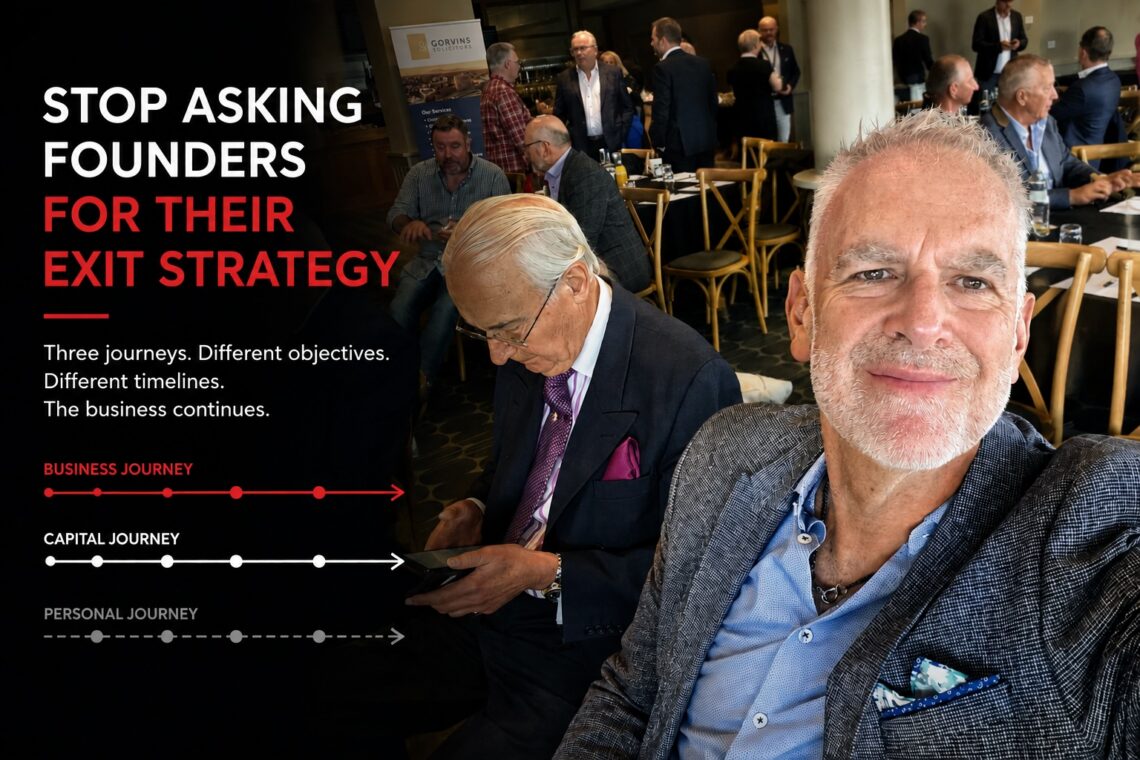
Stop Asking Founders for Their Exit Strategy
“What’s your exit strategy?”
It is one of those questions founders hear repeatedly when raising capital. It sounds perfectly reasonable, but it can cause considerable confusion because it mixes together three very different things. A founder may intend to run the business for another 20 years, the company may have a growth plan extending well beyond the investment being discussed, while the investor asking the question may need to realise a return within five, seven or ten years.
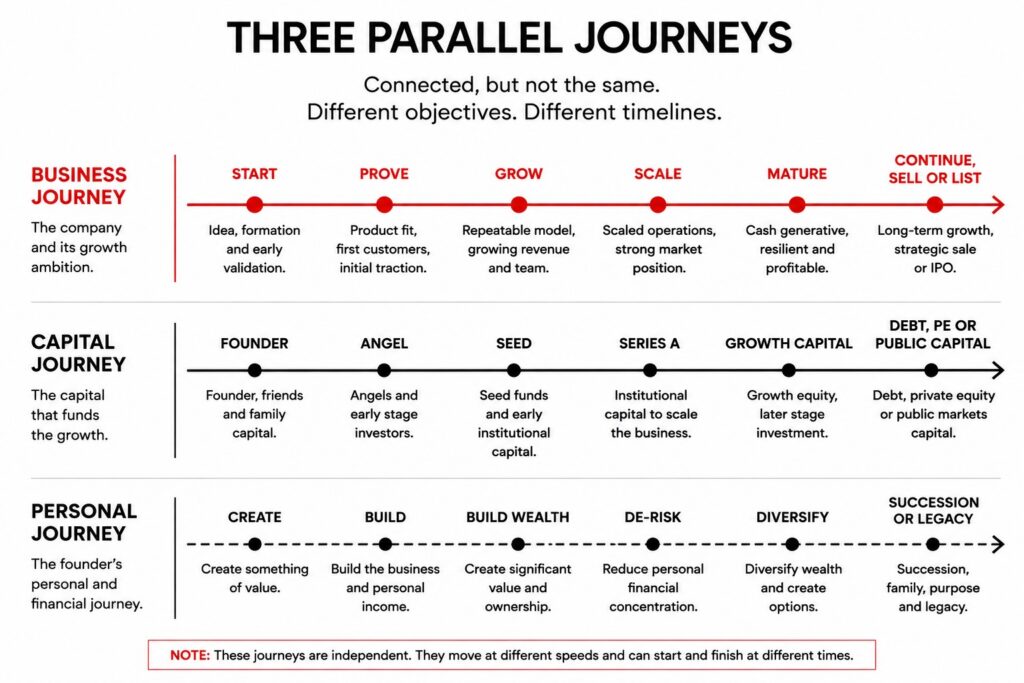
The business journey, the investor’s capital journey and the founder’s personal journey are connected, but they are not the same thing. Perhaps the starting question should therefore be: exit from what, and for whom?
The business does not necessarily exit
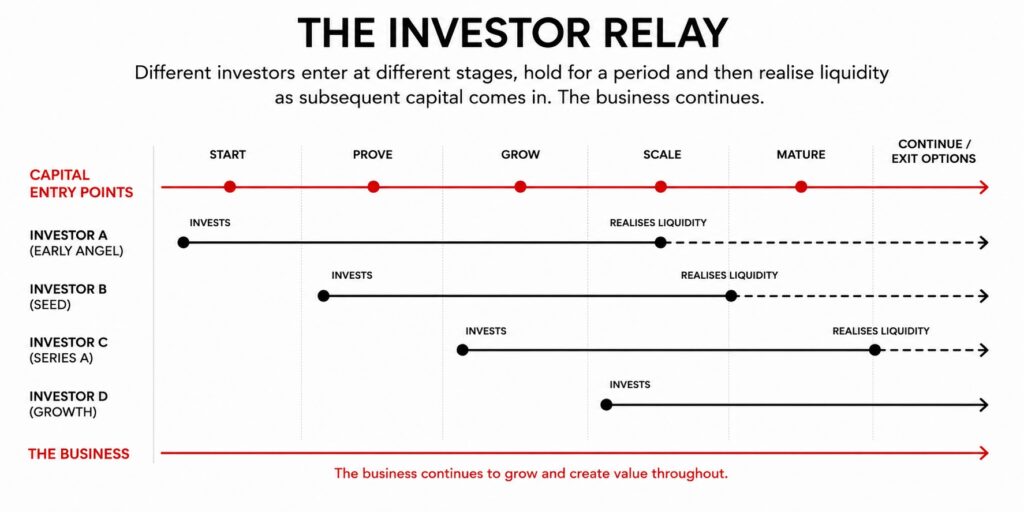
The language of “exit strategy” can make it sound as though everyone is working towards the day the company is sold. That is one possible outcome, but successful businesses can continue for decades while their investors change repeatedly.
An angel can sell some or all of their holding to a later investor. An early VC can realise its investment through a secondary transaction. One private equity investor can sell to another. The company may buy shares back, while an IPO can create liquidity for shareholders without the underlying business being sold.
Revolut provides a good example. In 2024, a secondary share sale valued the company at $45 billion and allowed employees, alumni and early investors to realise value from their shares while bringing new investors into the business. Revolut continued as the same independent private company.
Capital can exit without the company exiting.
Every investor has a clock
There is, however, a perfectly legitimate question sitting behind “what’s your exit strategy?” An investor needs to understand how their money eventually comes back and what return they might make. A VC fund has its own investors, usually Limited Partners, whose capital ultimately needs to be returned, together with whatever return the fund generates.
The current UK market illustrates the issue. British Business Bank analysis found that UK VC funds from 2002 to 2020 vintages had generated total value equivalent to 1.84 times invested capital, but only 0.69 times invested capital had actually been distributed back. Some 54% of UK fund managers surveyed still described exit conditions as poor or very poor, although 68% expected them to improve.
There can therefore be considerable value sitting inside successful companies which investors still need to turn back into cash. Rather than asking when the company will exit, the more useful question is what credible routes exist for that particular investor to achieve liquidity and over what period.
There is more than one way out
A full sale of the business is only one route. A trade sale allows another company to acquire the business, while a secondary transaction allows an existing shareholder to sell some or all of their position without selling the company. Later institutional investors can provide liquidity for earlier investors, management or the company may buy shares back, and private equity can replace one generation of investors with another.
An IPO provides another route, allowing shares to become publicly traded while the underlying company continues. Founders can also use secondary transactions to realise part of their wealth without necessarily giving up control or leaving the business.
OrganOx provides the more traditional example of an exit. The Oxford University spinout received multiple rounds of external investment before being acquired by Terumo in October 2025 for approximately $1.5 billion. BGF, which first invested in 2019 and participated in subsequent rounds, reported £175 million of proceeds and a 10 times return on its initial investment.
Revolut and OrganOx therefore demonstrate two very different outcomes. Revolut provided liquidity to existing shareholders while continuing independently. OrganOx was acquired outright. Both created an exit for investors, but only one involved the sale of the company.
Put exit inside the Capital Journey
A business may require £500,000 today, £3 million in two years and £10 million several years later. Treating those as three unrelated transactions ignores what happens between them.
Each funding round changes the Cap Table. New investors enter at different valuations, with different return expectations and investment horizons. Existing shareholders are diluted, while later rounds can create opportunities for earlier investors and founders to take some money off the table.
The Capital Journey should therefore map the likely funding requirements over several years, what each round needs to achieve, the appropriate type of capital and potential liquidity points along the way. Alongside it, the Cap Table Journeymodels what those transactions could mean for ownership, valuation and dilution.
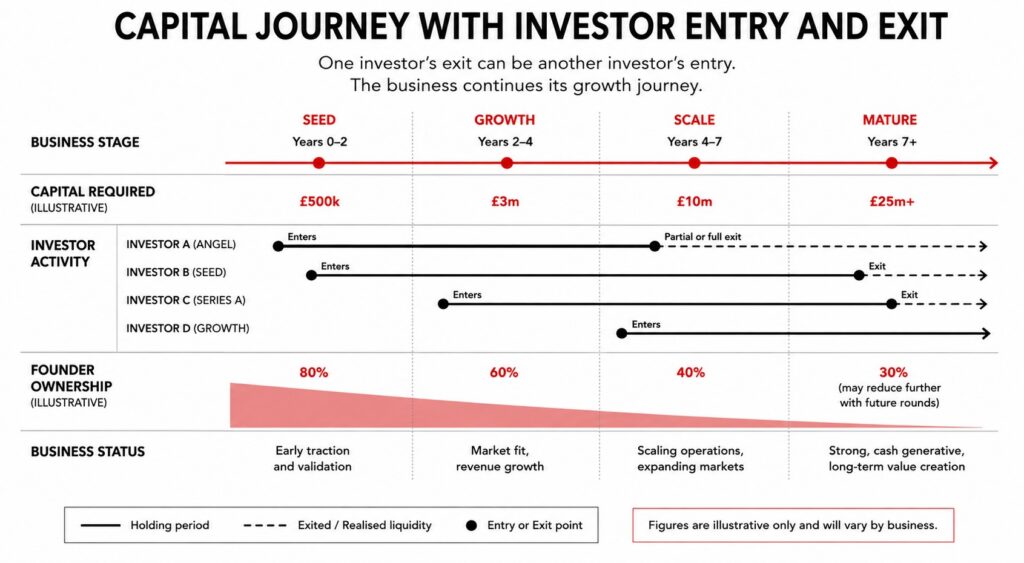
One investor’s exit can therefore be another investor’s entry point, while the company continues along its growth journey. This also changes how the first investment should be considered. A valuation or equity deal that looks attractive today can produce a very different result after several subsequent rounds, particularly if the likely Cap Table Journey has never been modelled and founder equity is progressively chipped away.
Then there is the founder’s journey
Founders can have very different ambitions. One may want to build and sell, another may want to remain CEO for decades, while another may eventually step away from management but retain significant ownership. A founder may also want to realise part of their wealth, reduce personal financial exposure and continue building the company.
As the business matures, the questions can change again. Succession, family, retirement, philanthropy, intergenerational wealth and legacy may become more important than another funding round, without requiring the business itself to be sold.
This is why the company journey and the founder’s personal journey need to be considered separately. The business strategy asks where the company is going, what capital it requires and what needs to be built to get there. The personal journey asks what the founder actually wants from the value being created, both financially and personally.
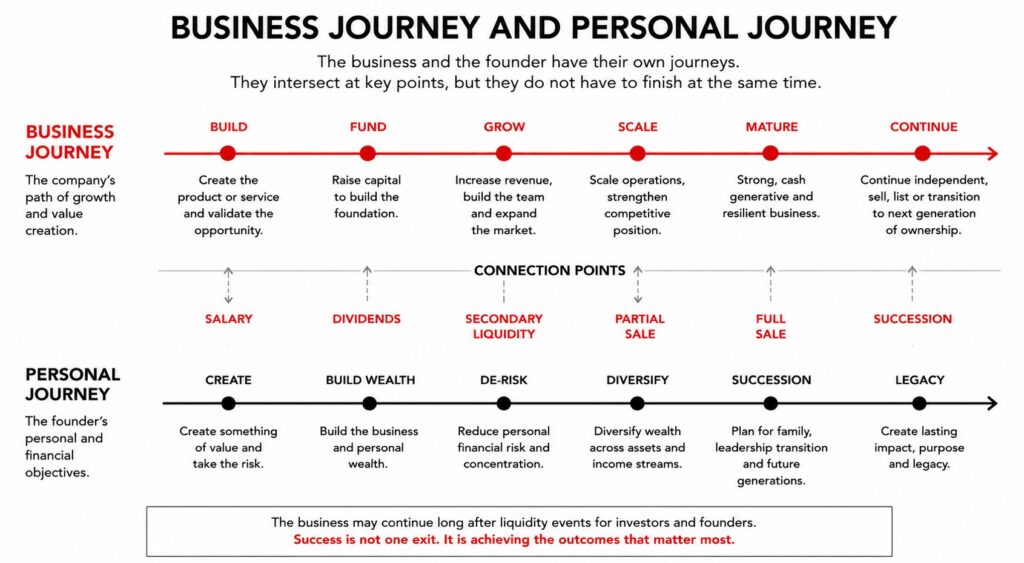
A founder can build a business worth £30 million while still having most of their personal wealth concentrated in one illiquid asset. Personal wealth, succession and family planning therefore need to start well before somebody appears with an offer to buy the company.
Three journeys, not one exit
At Kognise, the approach is increasingly to separate these three journeys. The Business Journey looks at where the company is going and what needs to be built to get there. The Capital Journey looks several funding rounds ahead, considering the amount and type of capital required, valuation, milestones, investor expectations and potential routes to liquidity.
Alongside these sits the Personal Journey, developed through the Family Legacy work, looking at what founders and directors ultimately want from the value being created, including wealth, diversification, succession and legacy. The three journeys need to work together, but they should not be confused with each other.
Change the question
Instead of simply asking a founder, “What’s your exit strategy?”, perhaps the better question is: what is the long-term ambition for the business, what Capital Journey supports it, and where are the likely opportunities for investors to realise their returns?
There is then a separate question for the founder: what do you ultimately want from the business and the value you are creating?
Those questions recognise that a company may continue through several generations of capital and ownership. They also recognise that the founder’s destination does not have to be the same as the company’s.
The business has a journey. Each investor has an entry point, return requirement and eventual route to liquidity. The founder has a personal journey which may continue long after an investor has left, and potentially long after they have stopped running the company.
The objective shouldn’t be to plan one exit. It should be to understand who needs to enter, who needs to leave, when, and where the business and its founders are ultimately trying to go.


